
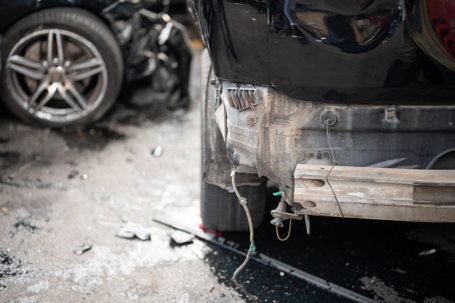
A REAR-END CRASH CAN LOOK SIMPLE. The car in the back hit the car in front. Case closed, right?
Not always.
In New York, determining who is responsible for a rear-end collision can depend on what happened in the moments before impact, where each vehicle was positioned, whether traffic was moving or stopped, and whether there is evidence that changes the basic picture.
If you were rear-ended in Queens, Brooklyn, the Bronx, Nassau County, Suffolk County, or elsewhere in New York, understanding how fault is evaluated can help you make informed decisions about your claim.
Is the Driver Who Hit You From Behind Automatically at Fault?
Generally, a driver who strikes another vehicle from behind may face a strong presumption of fault because drivers are expected to maintain enough distance and control to avoid hitting the vehicle ahead.
But “rear-ended” does not automatically mean every question about liability disappears.
The circumstances still matter.
For example, the other driver may argue that the vehicle in front stopped suddenly, changed lanes unexpectedly, or created an unsafe situation. In a multi-vehicle collision, the sequence of impacts can also become important. A driver may have been pushed into another vehicle after being struck from behind.
That is why it is important not to assume that the insurance company will automatically see the crash the same way you do.
New York also follows comparative negligence principles, meaning fault can potentially be divided among parties rather than always assigned entirely to one driver. (NYSenate.gov)
What Evidence Can Help Establish Fault?
After a rear-end collision, evidence can become extremely important.
Photographs of the vehicles can show where the impact occurred and the type of damage sustained. Photos of the roadway, traffic signals, lane markings, weather conditions, and the surrounding area may also help explain what happened.
A police report can provide another account of the collision, although it is only one piece of the overall evidence.
Witness statements can be valuable, especially when the drivers give different versions of what happened. If someone saw the vehicles immediately before impact, that person may have information that helps clarify the sequence of events.
Video can be especially powerful.
Dashcam footage, nearby surveillance cameras, traffic cameras, or other available recordings may capture the moments leading up to the crash. Modern vehicles and mobile devices can also create records that may become relevant to a collision investigation.
The sooner evidence is identified and preserved, the better.
What If the Other Driver Says You Caused the Crash?
THIS IS WHERE THINGS CAN GET COMPLICATED.
Insurance companies do not necessarily accept one driver’s version of events without investigation. If the other driver disputes responsibility, the insurer may review photographs, vehicle damage, statements, police reports, available video, and other information.
You should also be careful about making assumptions or giving a detailed statement before you understand exactly what evidence exists.
Even something that seems harmless—such as saying “I probably stopped too quickly”—could later be interpreted differently during an insurance investigation.
Stick to the facts you know.
You were there. You know what you experienced. Preserve the evidence and avoid guessing about facts you cannot confirm.
Does the Damage to the Vehicles Matter?
It can.
The location and pattern of vehicle damage may help investigators understand how the collision occurred. Damage to the rear of one vehicle and the front of another may support a particular sequence of events, but vehicle damage should be considered together with the other evidence.
This becomes even more important when several vehicles are involved.
For example, imagine a chain-reaction collision in traffic. One vehicle strikes another, which then moves into a third vehicle. Determining who caused the initial impact and which impacts led to particular injuries or damage may require closer investigation.
That is not something you should have to figure out on your own while also dealing with medical treatment, vehicle repairs, and insurance calls.
What Should I Do After a Rear-End Collision?
Start by getting medical attention if you are injured. Some crash-related injuries may not become obvious immediately.
Report the collision as appropriate, exchange information, photograph the vehicles and scene if it is safe to do so, and preserve any potentially useful evidence.
Keep records related to medical treatment, missed work, vehicle damage, and communications with insurance companies.
Most importantly, do not assume that a seemingly straightforward rear-end collision is automatically a straightforward claim.
The insurance company will evaluate the facts from its own perspective. You should have someone looking at the evidence from yours.
How Can Law Office of Seni Popat, P.C. Help After a New York Rear-End Collision?
If you were injured in a rear-end collision, Law Office of Seni Popat, P.C. can review the circumstances surrounding the crash, help identify important evidence, and explain your legal options.
Whether your collision happened in Queens, Brooklyn, the Bronx, Nassau County, Suffolk County, or elsewhere in New York, you do not have to guess your way through the aftermath.
CONTACT Law Office of Seni Popat, P.C. at (718) 340-3385 to discuss your case and learn what steps may be available to you.